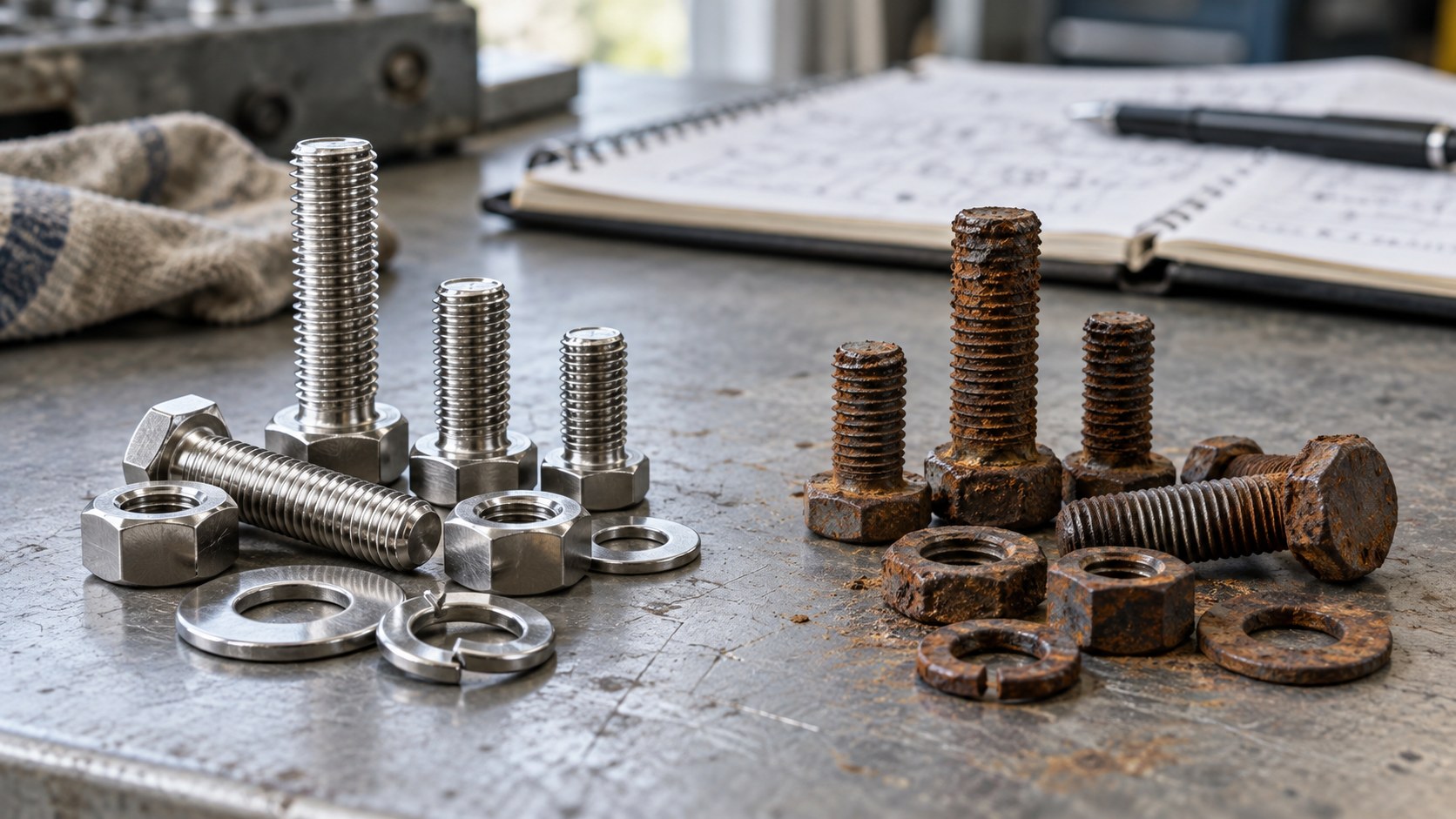
Material comparison for illustrative purposes only; not a test result.
Short answer: A more sustainable fastener is a suitable connection with the longest possible functional service life within the application. Compare materials, corrosion protection, maintenance, and replacement frequency, and request information on origin and environmental impact whenever possible.
Consider the usage phase
A low material cost at the time of purchase is not automatically advantageous if the connection fails prematurely or needs to be replaced frequently. Describe the intended service life of the installation, the inspection frequency, and the consequences of disassembly. For a connection that is difficult to access, maintenance can account for a large portion of the actual burden on personnel and resources. In a module that is easy to replace, a different approach may be appropriate. Therefore, compare alternatives based on the same function and time horizon.
Materials and the environment go hand in hand
Moisture, salt, chemicals, temperature, and contact with other metals all influence corrosion risks. “Stainless steel” is not a complete specification; neither is a coating. Ask which material type and any surface treatment are suitable for both the environment and the mechanical load. Check for crevices, trapped moisture, and contact corrosion throughout the entire assembly. A fastener with good nominal corrosion resistance can still cause problems in an unfavorable design. Consult the designer and a specialist before a material or coating becomes the default choice.
Design for Assembly and Maintenance
An assembly that is installed consistently and in a verifiable manner is in a better position than one that only looks good on paper. Are the tools accessible? Can the prescribed assembly procedure be followed? Can parts be inspected and, if necessary, removed? Also consider the number of variants in a machine. Fewer unnecessary variants simplify inventory and maintenance, as long as the technical requirements are maintained. Document these choices in the bill of materials and work instructions.
Ask for data, not a green label
To make an informed comparison, you need product information: material, origin (where available), treatment, packaging, and relevant documentation. Ask the supplier what data is available at the item or lot level and what its limitations are. A general claim about “sustainability” without specific details is not very meaningful. The European CBAM framework may be relevant for certain imported goods, but its applicability and associated obligations depend on the current product classification and role in the supply chain. Have the responsible import or compliance function conduct this assessment; do not use CBAM as a synonym for the environmental performance of an individual bolt.
Compare based on the same functional unit
Suppose two options serve the same connection over an intended service life. In that case, note down for both the expected number of replacements, the maintenance procedures, and the substantiated data on materials and treatment. If that data is missing, state that explicitly. Do not draw a precise CO2 conclusion based solely on the mass of the bolt or a general material name. A life-cycle comparison requires well-defined data; for an initial technical selection, a transparent qualitative comparison is often valuable in itself.
Origin and Supply Chain
Ask what information is available at the product, batch, or supplier level and how up-to-date it is. A country of origin alone says little about the entire production chain or environmental impact. For goods that may fall under CBAM, specific rules will apply under the final European regime starting in 2026. Have the applicable commodity code and your role in the supply chain verified against the European Commission’s current information. This verification is distinct from assessing the environmental performance of an individual fastener.
What decision can you make tomorrow?
Select one fastener that is replaced frequently or has a corrosion problem. Identify its function and environment, examine the reason for replacement, and compare two technically feasible options. Ask what data and documents are available. Discuss with maintenance whether the replacement frequency can realistically be reduced. If the outcome is uncertain, plan a trial and define in advance what would constitute an improvement. This ensures that durability remains linked to the application’s measurable performance.
A consideration without false precision
Two materials are technically feasible for an outdoor connection. Option A is immediately available but requires regular inspection in the current environment; option B requires a different procurement and installation approach. Without reliable data on service life or production impact, you cannot honestly determine which choice has the lowest environmental impact. You can, however, make the questions explicit: how often does the connection need to be opened, what happens in the event of corrosion, and what data can the supplier provide to support their claims? Then develop a testing or inspection plan. A transparent uncertainty is better than a seemingly exact number without a basis.
When do you reconsider your choice?
A new cleaning agent, a different location, or a change in maintenance frequency can alter the original material selection criteria. Therefore, document the assumptions that guided the selection. Re-evaluate the connection when conditions change, and compare inspection results with the expected service life. A choice that is appropriate today under known conditions will not automatically remain suitable after a process change. Ensure that such maintenance-related signals are relayed back to engineering and procurement.
Make the trade-off clear
Compare two viable options based on the same criteria: technical suitability, expected service life, inspection and replacement, available data, availability, and total cost. Note where evidence is lacking. If one option has a longer service life but a longer lead time, the risk associated with a planned maintenance shutdown should also be factored into the decision. A brief decision memo is more valuable than a choice that cannot be reconstructed later.
A more sustainable fastener is not a product category in and of itself. It is the best-informed choice for a specific application. Have you considered the material, environment, and service life requirements? We’d be happy to work with you to identify suitable fasteners and provide the information you need to make a comparison.
More information