The Seven Pillars of Reliable Tools
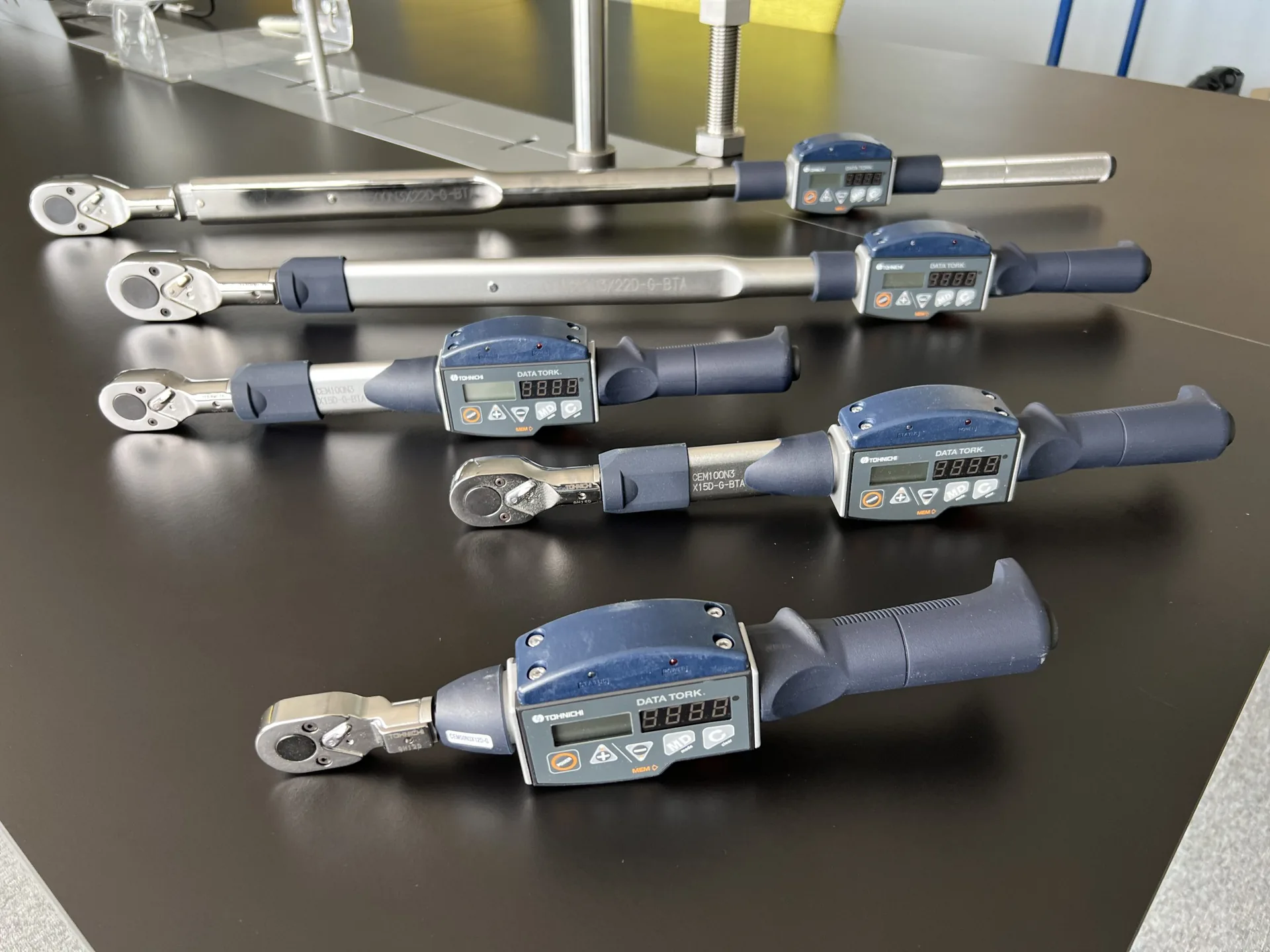
- Capacity & resolution accuracy: The torque range of the wrench must cover the required torque values, but the resolution determines repeatability. For dynamic loads, we recommend using no more than 70% of the rated capacity to minimize fatigue.
- Protective coating: On stainless steel, fiberglass-reinforced plastics, or live parts, a plastic or Teflon coating prevents contact corrosion, sparking, and surface hazards.
- Cyclical certified calibration: As a general guideline, keys lose approximately 0.5% of their accuracy per month in industrial use. Archey therefore employs a 6-month calibration cycle with fully traceable certificates, ensuring that audit spreadsheets and actual values match perfectly.
- Calibration in accordance with ISO 6789-2:2017
- Recalibration must be performed at least once a year or after 5,000 cycles (whichever comes first).
- Calibration must be performed in accordance with a defined test protocol, including the determination of measurement uncertainty.
- Calibration must be traceable to internationally recognized standards (such as ISO/IEC 17025-accredited laboratories).
Total Cost of Ownership
Inexpensive tools may seem tempting at the time of purchase, but research shows that downtime and reassembly costs more than offset the initial savings. A premium torque wrench with a service contract pays for itself on average within nine months thanks to fewer production stoppages and fewer rejected parts.
What We Learn from Real-World Experience
Years of experience in the industry have shown that reliability lies in the details. It’s not the number of tools that matters, but their precision, suitability, and maintenance. Only a well-chosen and well-maintained torque wrench delivers consistent performance. This reduces failure costs, increases reliability, and improves quality assurance throughout the entire assembly process.
The Power of Consistency
Critical connections require consistent performance. Variations in force, fatigue, or inconsistent calibrations can have a direct impact on product quality and safety. By specifically choosing tools with consistent calibration and adopting a uniform approach to maintenance, you build a stable foundation for quality that lasts and remains verifiable.
Quality as a Prerequisite
In industries where precision and reliability are paramount, tools are not an afterthought. They are a prerequisite. Quality begins with the choice of materials, continues with proper application, and culminates in measurable reliability. High-quality tools help build trust among technicians, quality control personnel, and customers.
Real-World Example
At an international machine manufacturer, the switch to an Archey resulted in a 15% faster line startup after a changeover, thanks to the immediate availability of calibrated spare wrenches and real-time torque monitoring.