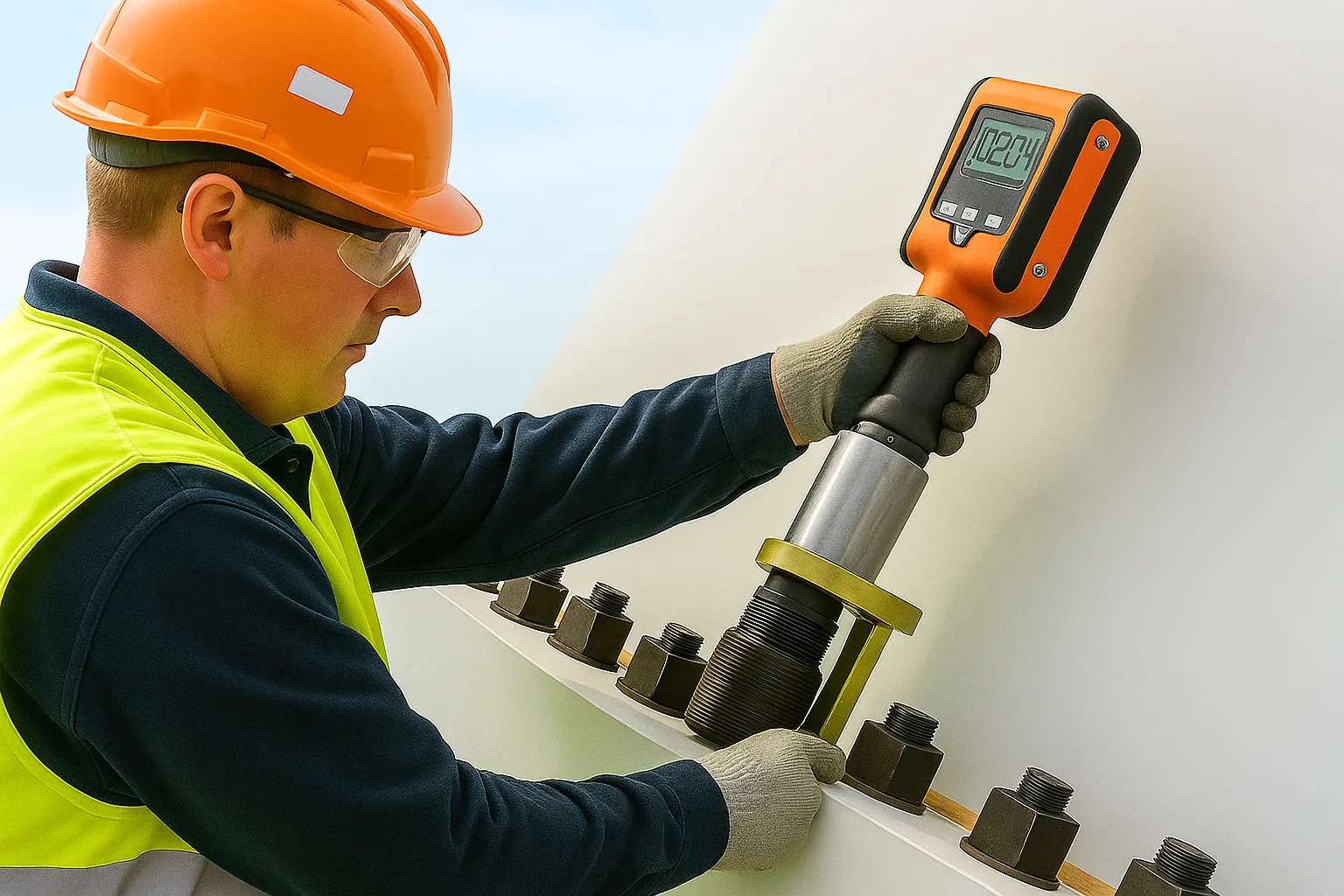
That is why Archey always goes beyond simply supplying fasteners: we also provide the expertise and tools needed to secure every connection exactly according to specifications.
Tightening Torque as a Quality Assurance Measure
In industries with high safety requirements—such as offshore wind, food and pharmaceutical facilities, or high-tech machinery manufacturing—torque values are legally mandated by standards and audit protocols. An error of just a few newton-meters can lead to costly downtime or injury. Archey maintains its own database of application- and material-specific torque values, supplemented by the practical experience of our product specialists. This means you receive not only theory but also validated practical values you can rely on.
From Theory to Practice
A theoretically calculated moment is just the beginning. To reproduce it in practice, you need:
- Torque wrenches and torque sockets in the appropriate range and accuracy class;
- Coated or insulated tools for hygienic, ATEX, or electrically critical environments;
- Regular calibration with a traceable certificate.
Each parameter affects the others. That is why we always provide a comprehensive solution: product + tool + calibration plan. This is the only way to ensure consistent quality.
Risks of “Uncontrolled” Assembly
Random samples show that 30% of unplanned production stoppages are indirectly related to incorrect torque settings. Examples include leaky flange gaskets in the chemical industry or body screws coming loose in the automotive industry. In virtually all cases, periodic recalibration of the tools and correct torque specifications could have prevented the downtime.
Archey’s Four-Step Method
- Analysis: We examine the drawing, materials, and load profile;
- Selection: We select the optimal fastener, including recommendations for surface treatment or lubricants;
- Torque mapping: we convert the load into a controllable torque;
- Quality Assurance: We provide calibrated tools, instructional training, and ISO-compliant reporting.